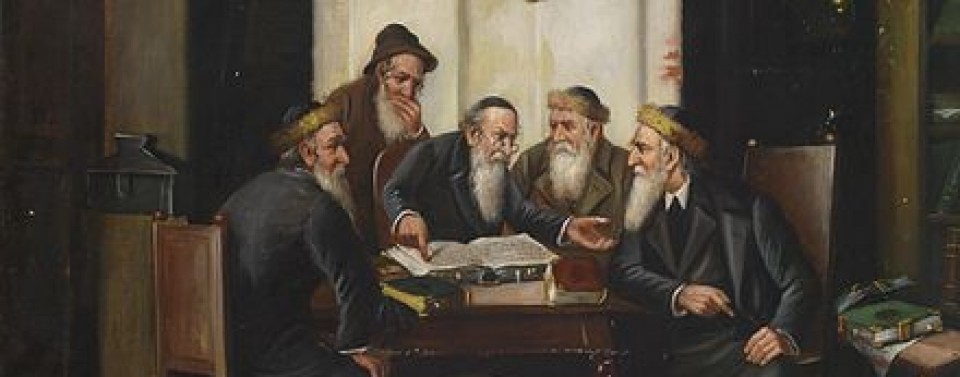
• About Today’s Rabbi

Today's Rabbi

~ …for you, a little wisdom!

Today's Rabbi

Tag Archives: tikkun olam

Plant Your Tree Before Greeting the Messiah!

19 Friday Feb 2016

Posted by joelaur in Rabbinic Sages, Uncategorized

≈ Leave a comment

Tags

Joe Laur, Messiah, tikkun olam, todays rabbi, Yohanan ben Zakkai

“If you have a sapling in your hand, and someone should say to you that the Messiah has come, stay and complete the planting, and then go to greet the Messiah.”

–Rabbi Yohanan ben Zakkai (Avot de Rabbi Nathan, 31b).

a-girl-scout-volunteer-shows-her-pride-in-planting-this-tree-725x483

All of us, in some way, at some time in our life, have been waiting for the Messiah to come. Whether it’s a political candidate we hope is The One, or our True Love to arrive and take us to the Promised Land, or the right job, guru, advisor, boss, buddy to show up, we have all been “Waiting for Godot” in some way, shape, or form.

Rabbi Yohanan’s words may come as a shock then. Plant the tree and then greet the Messiah? The one we’ve been waiting for our whole lives? How can that be right?

First, Reb Yohanan’s words are about hearing that the Messiah has arrived. We hear many things every day that just aren’t so. Why leave our “tree” unattended, our task unfinished   while we run after every rumor?  Secondly, if we are engaged in an important task, “planting a tree”; involved in restorative, renewing work, shouldn’t we follow it through? If it really is the Messiah arriving, isn’t this what they would want anyway, to pursue our unique mission and purpose? If it really is the Messiah, they will wait for us to finish the  Task! And third, once we have “planted our tree”, discharged our sacred work, we can turn with full mind, body, and soul to Greet the One without distraction.

What if our planting that particular “tree” is the final task that actually brings “the Messiah”? What if the “Messiah”  is everyone we meet, and we can greet each other as such. And isn’t it fitting to welcome the “Messiah” in each other into a verdant garden full of “trees”?

What tree can you plant today to create the garden worthy of the Messiah?

~~~~~~~~~~~~~~~~~~~~~~~~~~~~~~~~~~~~~~~~~~~~~~~~~~~~~~~~~~~~~~~~

Yohanan ben Zakkai (30 BCE – 90 CE),also known as Johanan B. Zakkai, or in short Ribaz, was one of the tannaim, an important Jewish sage in the era of the Second Temple, and a primary contributor to the core text of Rabbinical Judaism, the Mishnah. He is widely regarded as one of the most important Jewish figures of his time.

Joe Laur is a father, husband, naturalist, executive, consultant, and a lowly rabbinic student. He can be reached at joe.laur@godsdog.net.

Don’t be a Pious Fool!

15 Monday Feb 2016

Posted by joelaur in Rabbinic Sages, Uncategorized

≈ 1 Comment

Tags

charity, Joe Laur, social justice, talmud, talmudic wisdom, tikkun olam, todays rabbi

“Who is a person of piety and still a fool? Imagine a man who sees a woman drowning, but says,”It would not seem right for me, a religious man, to to touch a woman, and therefore I cannot pull her out.”

-Talmud

1024px-Wassilij_Grigorjewitsch_Perow_002

My father in law says there are two kinds of people in the world: those who say, “I’d love to but…”, and those who say, “What time and where?” In other words, those who show up and those who don’t.

The rabbis of the Talmud paint an extreme picture in the story above, but how often do we wring our hands or turn our gaze from situations we could act to correct? Our excuses are righteous and legion: too busy, have our own needs to look after, might get sued, probably a con, etc.

When a person stands on the side of the road  or walkway with a sign that says “Homeless- Please Help” or “Will Work for Food”, do we listen to the righteous, even pious voice that says; “Probably a drunk or addict, my money will just go for drugs or booze”, or ” I can’t help everybody, they need to rely on themselves”? Or do we focus on the person here, now, before us, and take the chance that we might get conned, but help them anyway in case there is real need?

In our home, we have begun the practice of buying gift cards at a local grocery chain for small amounts, $2-5 each. We buy 50 bucks worth, and keep them in the car and in our pockets, purse or wallet. Then we hand a card to anyone who holds up a sign or asks for spare change. “Here take this, you can get some food at this grocery.” No one has scowled back yet- most light up and thank us. How do we know for sure who is drowning and who is not? So we let ourselves be “suckers” and give a little to everyone. It doesn’t go to booze, and I know it does some good, because of the way I feel doing it.

Who is drowning around you? What lifesavers can you throw?

~~~~~~~~~~~~~~~~~~~~~~~~~~~~~~~~~~~~~~~~~~~~~~~~~~~~~~

The Talmud (Hebrew for “instruction, learning”) is a central text of Rabbinic Judaism.  The term “Talmud” normally refers to the collection of writings named specifically the Babylonian Talmud  although there is also an earlier collection known as the Jerusalem Talmud. The Talmud has two components: the Mishnah (c. 200 CE), a written compendium of Rabbinic Judaism’s Oral Tradition; and the Gemara (c. 500 CE), an elucidation of the Mishnah and related writings that often ventures onto other subjects and expounds broadly on the Hebrew Bible. The term “Talmud” may refer to either the Gemara alone, or the Mishnah and Gemara together.

The entire Talmud consists of 63 tractates, and in standard print is over 6,200 pages long. It is written in Tannaitic Hebrew and Aramaic, and contains the teachings and opinions of thousands of rabbis (dating from before the Christian Era through the fifth century CE) on a variety of subjects, including law,  ethics, philosophy, customs, history, lore and many other topics. The Talmud is the basis for all codes of Jewish law, and is widely quoted in rabbinic literature.

Joe Laur is a father, husband, naturalist, executive consultant, and a lowly rabbinic student. He can be reached at joe.laur@godsdog.net.

Better Tomorrow Than Today

31 Sunday Jan 2016

Posted by joelaur in Historic Voices, Uncategorized

≈ Leave a comment

Tags

inner work, Joe Laur, perfection, personal improvement, Reb Nachman of Bratslav, tikkun olam

 “If you are not a better person tomorrow than you are today, who needs tomorrow?” – Reb Nachman of Breslov

33-1252864863HrCL

If the Sabbath is about rest and renewal, the rest of the week is about making things happen. “Six days shall you labor and do your work, and on the seventh day you rest.”

This mentioned at least seven times in the Torah and repeated again in the Prophets and the Gospels. We often focus on the imperative to rest one day of seven. But the flip side is that we are also told to work the rest of the week. But what kind of work?

There’s an saying that healing the world is an inside job. So whatever our work in the world may be, it starts with ourselves. With working on our own stuff, our issues, our strengths and weaknesses. That way, whatever our work in the outer world, we are better equipped to do it well.

Reb Nachman reminds us that while we don’t have to do it all at once, we should still strive to make a little progress every day. We are to make tomorrow a bit better than today was. Otherwise, what’s the point of tomorrow?

What work can I do today, to make tomorrow better?

Nachman of Breslov, also known as Reb Nachman of Bratslav, (April 4, 1772 – October 16, 1810), was the founder of the BreslovHasidic movement.

Joe Laur is a father, husband, artist, builder, naturalist, consultant, and EcoKosher mashgiach. He lives with his wife Sara in western Massachusetts, where he serves as head groundskeeper and resident singer songwriter. Send him your favorite teaching quote for commentary. He can be reached at joe.laur@joelaur.com.

Repairing the World

21 Thursday Jan 2016

Posted by joelaur in Rabbinic Sages, Uncategorized

≈ Leave a comment

Tags

Rabbi Tarfon, social justice, tikkun olam

“You are not obligated to complete the work, but neither are you free to desist from it…”                   –Rabbi Tarfon, Pirkei Avot 2:16

Rabbi Tarfon was a member of the third generation of the Mishnah sages, who lived in the period between the destruction of the Second Temple (70 CE) and the fall of Betar (135 CE).

The Creation mythology of Genesis reveals G!D spending 6 days creating the world, in an evolving process of proclamation, separation, development, and emergence. In organizational consult terms, continuous improvement. And then G!D took the seventh day off.

It is taught that not only should we take every seventh day, Shabbat, off ourselves, but we too, should labor the other 6 to continue the work of bringing forth an emerging world, doing our best to improve it. This process is known in Hebrew as Tikkun Olam– healing, repairing, restoring and renewing the world.

world-in-hands

What is that work for us today? For many it is pursuit of healing of bodies and souls, justice for the long, old, and weak, and conservation and renewal of the planet we inhabit. Just as Providence brings forth grapes, grain, and maples, and we make wine, bread, and syrup, the work of tikkun is seen as partnering with the Divine to evolve a more perfect world. Visiting the sick and imprisoned; freeing captives; protecting children; physical, emotional, and spiritual healing; rebuilding communities and lives, all are examples of tikkun olam.

And as Rabbi Tarfon so succinctly puts it, we do not have to finish the work ourselves. Whew! How many of us have burned out or worn ourselves to a nub trying to do it all? Great News! We don’t have to!

But neither may we sit on our hands, or wring them sympathetically , while standing by doing nothing. We are tasked. If we see something, we ought not just to say something, but to DO something. The apostle James famously wrote that faith without works is dead.

We don’t need to take the world on our shoulders, Atlas is doing a fine job of that. But we can each lift up our bit of it, and in so doing, become partners with The One in bringing forth a world we’d want to live in.

What catches your attention today? What are you being called to  repair, heal, restore, renew?

Joe Laur is a father, husband, artist, builder, naturalist, consultant, and EcoKosher mashgiach. He lives with his wife Sara in western Massachusetts, where he serves as head groundskeeper and resident singer songwriter. Send him your favorite teaching quote for commentary. He can be reached at joe.laur@joelaur.com.

Perfection and Evil

20 Wednesday Jan 2016

Posted by joelaur in Contemporary Sages, Uncategorized

≈ Leave a comment

Tags

Irving Greenberg, peerfection, perfection and evil, tikkun olam

“Those who insist on perfection or nothing will surrender the world to evil…”

-Rabbi Irving Greenberg

Rabbi Irving Greenberg, also known as Yitz Greenberg, is a Modern Orthodox rabbi, Jewish-American scholar and author. He is known as a promoter of greater understanding between Judaism and Christianity.

I only spent a few hours one weekend studying with Rabbi Greenberg, but the teaching above was a major takeaway. I once had a man come up to me and tell me that I didn’t care about the environment because I wore a watch with a battery instead of a windup one. Never mind that I run my house on solar power, compost everything, recycle the rest, drive an electric car and work with major corporations on sustainability issues, I was less than perfect, and therefore no good.

perfection.jpg

Well, I’m guilty of that charge of lack of perfection. While I’m always striving for a positive impact on the world, I leave a few scars now and then. I am far from the ideal. But the point is to always make the effort, however big or small, to move the needle in the right direction. One small course correction can send us to an entirely different destination. And giving up ensures that I won’t have much of an impact on the things I care most about.  I’m reminded of this lesson time and again in raising children. While the good may be the enemy of the perfect, insistence on perfection may destroy the good.

Let’s not let ourselves off the hook, but let’s not hang ourselves on the hook, either! We were born to be real, not perfect.

What imperfect good thing can you begin today, and build upon tomorrow and the days after that?


Joe Laur is a father, husband, artist, builder, naturalist, consultant, and EcoKosher mashgiach. He lives with his wife Sara in western Massachusetts, where he serves as head groundskeeper and resident singer songwriter. Send him your favorite teaching quote for commentary. He can be reached at joe.laur@joelaur.com.

Recent Comments

Tim Laur's avatarTim Laur on The Danger of Being Certa…
joelaur's avatarjoelaur on The Danger of Being Certa…
Tim Laur's avatarTim Laur on The Danger of Being Certa…
AJ's avatarAJ on The Danger of Being Certa…
Elisheva's avatarElisheva on The Bridge Over Fear

Author

  • joelaur's avatar joelaur
    • What We Don’t Know CAN Hurt Us!
    • The Danger of Being Certain
    • The Soul’s Long Journey
    • Acting Locally and Cosmically
    • The Fullness of the Earth
    • The Enemy is Fear
    • Running Against The Wind
    • Friendship as Food
    • No Place Like Home
    • Not The End Of The World

Blog at WordPress.com.

  • Subscribe Subscribed
    • Today's Rabbi
    • Already have a WordPress.com account? Log in now.
    • Today's Rabbi
    • Subscribe Subscribed
    • Sign up
    • Log in
    • Report this content
    • View site in Reader
    • Manage subscriptions
    • Collapse this bar
 

Loading Comments...