One Key To Wisdom

Tags

, , , ,


“Who is wise? The one who learns from everyone”

-Shimon ben Zoma

grandfather-and-grandchild-1365226773XdV

Today’s post is as sweet and simple as the maple syrup I’ll soon be making from the trees on my land.  Opportunities to learn are all around us, in nature, in our neighbors, in ourselves. There is a Native American story about two lost boys who discover a rock in the forest that tells them stories. They gather all the people to sit around the rock for days, hearing all the stories that there are in the world. No one person will remember them all, but everyone will  remember some of them, and if they share with each other, they will remember them all, collectively.

So it is with all learning. We can’t have it all within us, but by reaching out to people and creation around us, we can access the encyclopedia of the cosmos. We are all each other’s teachers and students, repositories of wisdom at just the right moment.

Who can you learn from today?

Simeon ben Zoma, also known as Simon ben Zoma, Shimon ben Zoma or simply Ben Zoma  was a Tanna of the first third of the 2nd century CE. His name is used without the title “Rabbi” because he died at a young age, remaining in the grade of “pupil” and never receiving rabbinical ordination.

Joe Laur is a father, husband, naturalist, executive consultant, and a lowly rabbinic student. He can be reached at joe.laur@godsdog.net.

We All Cast Shadows

Tags

, , , , ,

Look, see the long shadow cast by the trees;
And flowers and people throw shadows on the earth:
What has no shadow has no strength to live.

-Czeslaw Milosz

Looking_down_from_The_Eiffel_Tower,_Paris_8_April_2007
By Elliot Moore from London, England (Shadow People) [CC BY-SA 2.0 (http://creativecommons.org/licenses/by-sa/2.0)%5D, via Wikimedia Commons

This closing  refrain from the poem “Faith” by  Czeslaw Milosz reveals a telling truth about the human condition. We all cast shadows. And not just the kind that Peter Pan became detached from and had to have stitched back on. We all have psychic shadows as well, parts of our selves that we repress, hide, deny; parts of ourselves that are unconscious or unknown to us.

Carl Jung said that we think we know about 80% of our psyche, and that 20% is hidden. But Jung claimed that in reality, we know about 20% of who we are, and that 80% is in shadow! What a lot of hidden material to work with!

We tend to think of shadow as the ‘bad’ stuff, the killer, abuser, cheat, philanderer, rascal, devil in us. And certainly we tend to want to ignore our less admirable traits. I certainly would if I had any! 🙂 But that’s only part of the picture.

We have “golden shadows” too, wonderful bits of us that we may be too shy, modest or just unaware to recognize and use. If we are made in the Divine Image, there’s glory in us all!

Even the nasty bits can serve a useful, if misguided purpose. The part that pushes away others keeps us from getting our heart broken. That sudden anger that flares up wants justice. The conniver and thief is usually trying to fill some worthy need.  Welcoming our shadows into the light, finding a better way to meet the “unmet needs” they are trying to satisfy, can bring us healthy new energy and purpose. Approaches like Shadow Work Seminars can help us alchemically transform our coal into gold. After all, we only have shadows because we are standing in the Sun.

What hidden parts of yourself need to be brought to light?

~~~~~~~~~~~~~~~~~~~~~~~~~~~~~~~~~~~~~~~~~~~~~~~~~~

Czesław Miłosz (30 June 1911 – 14 August 2004) was a Polish poet, prose writer, translator and diplomat. In 1978 he was awarded the Neustadt International Prize for Literature, and in 1980 the Nobel Prize in Literature. After the fall of the Iron Curtain, he divided his time between Berkeley, California, and Kraków, Poland.

Joe Laur is a father, husband, naturalist, executive consultant, and a lowly rabbinic student. He can be reached at joe.laur@godsdog.net.

Remaining an Artist

Tags

, , , ,

Every child is an artist. The problem is how to remain an artist once he grows up.

–Pablo Picasso

725165361

A colleague of mine likes to tell a story of walking into a preschool classroom, and asking the kids; “Who can sing?” “Who can dance?” “Who can draw?” As you can imagine every hand in the room goes up on each question. He then walked over to a nearby college, and asked a class of graduate students those same three questions. Hardly a hand went up. He wryly remarked, “We call this process ‘education'”.

Many of us have had our creativity bred or beaten out of us. The need to conform, to fit in, to perform in a specific way, often leaves our creative selves along life’s roadside gasping for air.  I remember an acquaintance who told me felt he had to leave his poetry behind to succeed in business. How sad! He wound up in a battle with addiction before he rediscovered his soul later in life.

And most of us went to the same schools- long rows, neat desks, telling the teacher up front what she or he had just told us, parroting it back to gain a grade. A freeze dried model of success and achievement. Small wonder our creative selves were under assault!

I owe much of my creative path to a teacher in high school who sent a pass into study hall, summoning me and a dozen other boys to the chorus room. He offered to teach us to sing together, to create art with our voices. We took him up on it, all diamonds in the rough. It changed the trajectory of my life, sending me from music to theatre to human potential work. He opened a creative urge that has never quieted since, and that helps me every day in every endeavor, artistic  or mundane. He helped me learn to turn Life into Art.

How can you nurture the life artist within you?

~~~~~~~~~~~~~~~~~~~~~~~~~~~~~~~~~~~~~~~~~~~~~~~~~~~~~~~~~~

Pablo Ruiz y Picasso, (25 October 1881 – 8 April 1973), was a Spanish painter, sculptor, printmaker, ceramicist, stage designer, poet and playwright.As one of the greatest and most influential artists of the 20th century, he is known for co-founding the Cubist movement, the invention of constructed sculpture, the co-invention of collage, and for the wide variety of styles that he helped develop and explore.

Joe Laur is a father, husband, naturalist, executive consultant, and a lowly rabbinic student. He can be reached at joe.laur@godsdog.net.

Don’t be a Pious Fool!

Tags

, , , , , ,

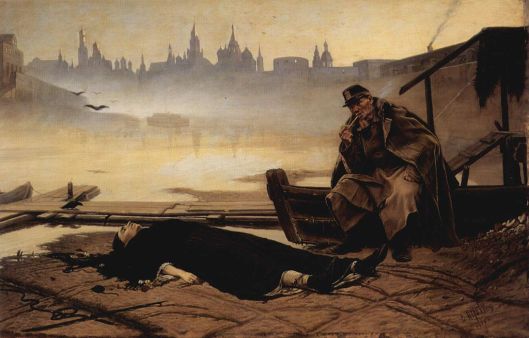
“Who is a person of piety and still a fool? Imagine a man who sees a woman drowning, but says,”It would not seem right for me, a religious man, to to touch a woman, and therefore I cannot pull her out.”

-Talmud
1024px-Wassilij_Grigorjewitsch_Perow_002

My father in law says there are two kinds of people in the world: those who say, “I’d love to but…”, and those who say, “What time and where?” In other words, those who show up and those who don’t.

The rabbis of the Talmud paint an extreme picture in the story above, but how often do we wring our hands or turn our gaze from situations we could act to correct? Our excuses are righteous and legion: too busy, have our own needs to look after, might get sued, probably a con, etc.

When a person stands on the side of the road  or walkway with a sign that says “Homeless- Please Help” or “Will Work for Food”, do we listen to the righteous, even pious voice that says; “Probably a drunk or addict, my money will just go for drugs or booze”, or ” I can’t help everybody, they need to rely on themselves”? Or do we focus on the person here, now, before us, and take the chance that we might get conned, but help them anyway in case there is real need?

In our home, we have begun the practice of buying gift cards at a local grocery chain for small amounts, $2-5 each. We buy 50 bucks worth, and keep them in the car and in our pockets, purse or wallet. Then we hand a card to anyone who holds up a sign or asks for spare change. “Here take this, you can get some food at this grocery.” No one has scowled back yet- most light up and thank us. How do we know for sure who is drowning and who is not? So we let ourselves be “suckers” and give a little to everyone. It doesn’t go to booze, and I know it does some good, because of the way I feel doing it.

Who is drowning around you? What lifesavers can you throw?

~~~~~~~~~~~~~~~~~~~~~~~~~~~~~~~~~~~~~~~~~~~~~~~~~~~~~~

The Talmud (Hebrew for “instruction, learning”) is a central text of Rabbinic Judaism.  The term “Talmud” normally refers to the collection of writings named specifically the Babylonian Talmud  although there is also an earlier collection known as the Jerusalem Talmud. The Talmud has two components: the Mishnah (c. 200 CE), a written compendium of Rabbinic Judaism’s Oral Tradition; and the Gemara (c. 500 CE), an elucidation of the Mishnah and related writings that often ventures onto other subjects and expounds broadly on the Hebrew Bible. The term “Talmud” may refer to either the Gemara alone, or the Mishnah and Gemara together.

The entire Talmud consists of 63 tractates, and in standard print is over 6,200 pages long. It is written in Tannaitic Hebrew and Aramaic, and contains the teachings and opinions of thousands of rabbis (dating from before the Christian Era through the fifth century CE) on a variety of subjects, including law,  ethics, philosophy, customs, history, lore and many other topics. The Talmud is the basis for all codes of Jewish law, and is widely quoted in rabbinic literature.

Joe Laur is a father, husband, naturalist, executive consultant, and a lowly rabbinic student. He can be reached at joe.laur@godsdog.net.
The Universe Wants You to Grow!

Tags

, , , , , ,

“There is not a single blade of grass that has not its own star in heaven that strikes it and says “GROW!”

-Genesis Rabbah

stalks-of-grass-in-road

Growth is natural. It’s what living things do. It simply happens  whenever the conditions for growth are present, which is most of the time in most places on Earth.

We can think of ourselves as the gardeners of our lives, not task masters, shouting “Grow, dammit!” at ourselves; or judges, critiquing: “You’d be further along if you weren’t such a dope.” We all grow at our own pace, depending on genetics and circumstances, nature and nurture. What’s the main role of the gardener? Simply to tend to that which limits growth, such as shade, poor soil, drought, and and provide that which fosters it, such as water, nutrients, sunlight.

We can use this wisdom in our own lives, removing the poor soils of harsh judgement of ourselves, the drought of lousy self care, the shade of shame. We can provide ourselves with rich soils of people who love and respect us, the water of blessing from self and others, the nourishment of investing in our own well being. When that’s done, healthy growth is inevitable. In fact it’s the Way of the World.

What do you need to tend in your “garden” to grow deeper and higher today?

~~~~~~~~~~~~~~~~~~~~~~~~~~~~~~~~~~~~~~~~~~~~~~~~~~

Genesis Rabba  is a religious text from Judaism’s classical period, probably 4th or 5th  century C.E. It is a midrash comprising a collection of ancient rabbinical homiletical interpretations of the Book of Genesis.

Joe Laur is a father, husband, naturalist, executive consultant, and a lowly rabbinic student. He can be reached at joe.laur@godsdog.net.

G!D Is The Whole System

Tags

, , , , ,

“Eternity is the very core of God” 

-Baruch Spinoza

VanGogh-starry_night_ballance1

Both belief in a particular vision of G!D or total atheism are huge acts of faith. Absolute proof cannot be made one way or the other, at least not by us. Who or what is G!D? I guess the best and truest answer is that we really don’t know. But here’s my working definition, one that Spinoza’s line resonates with, the one that brings some meaning to me:

G!D is the name we use for that infinite eternal system of which we are all a part and cannot fully fathom, because we can never stand apart from that system and see the whole. We, on our best days, can simply sense it’s enormity and stand in awe within it. It’s the whole thing: biosphere, microsphere, cosmos; a power of infinity inward  and outward until we reach the place where both connect. And as the letter writer Paul says, we only see it through a dark glass.

The important thing is not to comprehend it, but to relate to it. To call out in a voice loud, or one small and still, or just to listen to the enormous Silence.

May we see the Whole, may we achieve what is intended that can heal, avoid what is unintended that can harm, stumble upon what blesses. May our will and purpose align with the will and purpose of the Whole System, The All, The Singularity, The Unity. And all the Beings say: Amen.

How can you open to and align with the Whole in your life?

~~~~~~~~~~~~~~~~~~~~~~~~~~~~~~~~~~~~~~~~~~~~~~~~~~~~

Baruch Spinoza (24 November 1632 – 21 February 1677),  was a Dutch philosopher of Sephardi Portuguese origin. By laying the groundwork for the 18th-century Enlightenment and modern biblical criticism, including modern conceptions of the self and the universe, he came to be considered one of the great rationalists of 17th-century philosophy.

Joe Laur is a father, husband, naturalist, executive consultant, and a lowly rabbinic student. He can be reached at joe.laur@godsdog.net.

If Worrying Paid Off

Tags

, , , , , ,

“If worrying did any good, all the rich people would hire worriers!”

-Rabbi Zalman Schachter-Shalomi

natur-schutz

When I was in college, someone gave me a set of “trouble dolls”, six little figures in a box. I was supposed to tell them my troubles each night at bed, and let them carry them while I got a good nights sleep. There were only 6 dolls because I was only allowed to have that many troubles and no more! They were “worriers” I could hire for the night.

As Shabbat approaches each Friday night, my family and I review the week; the blessings and the struggles. As we ritually wash our hands before breaking bread, we wash away and release anything we need to let go of that would keep us from entering a state of peace and joy. And then we throw that water out onto the earth to be processed, recycled and renewed! This ritual allows us to put our worries aside for a day, and relax into the NOW. It’s a life saving break from woes. Repeat as needed.

What worries do you need to release right now to enter a place of peace?

Shabbat Shalom!

~~~~~~~~~~~~~~~~~~~~~~~~~~~~~~~~~~~~~~~~~~~~~~~~~~~~~

Zalman Meshullam Schachter-Shalomi, commonly called “Reb Zalman“, (28 August 1924 – 3 July 2014) was one of the founders of the Jewish Renewal movement and an innovator in ecumenical dialogue and spiritual practice.

Joe Laur is a father, husband, naturalist, executive consultant, and a lowly rabbinic student. He can be reached at joe.laur@godsdog.net.
When Work Is Play

Tags

, , , ,

“Only where love and need are one,
And the work is play for mortal stakes,
Is the deed ever really done
For Heaven and the future’s sakes.” – Robert Frost, “Two Tramps in Mud Time”

rucni-prace

A mentor of mine once remarked that if we knew what it was that G!D wanted us to do, we would be happy doing it, no matter what it was. Robert Frost wrote this piece, set during the Great Depression, about two homeless men who approach him while chopping wood, and offer to do the work for him so as to earn a little pay. The problem is, Frost is really having a great time chopping the wood himself! He agrees that their need trumps his enjoyment for the moment, but loves those tasks that marry avocation and vocation.

My work life has been blessed by one key thing: I’ve always done work I was interested in and that could make a difference in the world. From theatre to Rolfing to men’s work to corporate coaching to my rabbinic studies to my budding maple beverage business, I’ve never done something just for the money. Yet, I’ve always had enough, and often more than enough. I learned this lesson from my father, who passed up going to veterinary school in order to go into the construction business, because he was told he’d make more money. Several times in his life, he told me it was the only real regret he had. Everyone who saw  his love of animals knew he would have been a great vet! I learned early on, from his regret, to always do what I had a passion for. And thankfully, the money has flowed alongside the passion.

As Mark Twain wrote, “The secret of success is making your vocation your vacation.”

How can you spend more of your time at the work that gives you joy, that even G!D wants you to do?

~~~~~~~~~~~~~~~~~~~~~~~~~~~~~~~~~~~~~~~~~~~~~~~~~

Robert Lee Frost (March 26, 1874 – January 29, 1963) was an American poet. His work frequently employed settings from rural life in New England in the early twentieth century, using them to examine complex social and philosophical themes. One of the most popular and critically respected American poets of the twentieth century, Frost was honored frequently during his lifetime, receiving four Pulitzer Prizes for Poetry, the Congressional Gold Medal, and was named Poet Laureate of Vermont.

Joe Laur is a father, husband, naturalist, executive consultant, and a lowly rabbinic student. He can be reached at joe.laur@godsdog.net.


Keeping Score

Tags

, , , , , ,

“Even after all this time, the sun never says to the earth, ‘You owe me.’
Look what happens with a love like that. It lights the whole sky.” –Daniel Ladinsky 

sun

Sometimes in our lives, we keep score. “I did this for you, why can’t you do that for me?” We give with strings, and feel cheated if our loving is not returned in equal measure. Ladinsky implies here, writing in the name of Hafez, the great Persian mystical poet, that limited love produces limited results.

But love given without measure, without expectation of return, freely and fully, light ups the whole sky. And probably yields more returns than conditional love to boot. Keeping our eyes on the scoreboard limits our ability to be in the game, to be fully present to who is before us. What’s at risk, if we love unconditionally, beaming our affection, admiration, friendship, blessing as a pure gift rather than a shrewd bargain? More importantly, what’s at risk if we don’t love like that?

Who can you love completely today, just for love’s sake?

Daniel Ladinsky (born 1948) is an American poet and interpreter of mystical poetry, born and raised in St. Louis, Missouri. In introductions to his books, Ladinsky notes that he offers interpretations and renderings of poets, rather than literal or scholarly translations. His work is based on conveying and being “faithful to the living spirit” of Hafiz, Rumi, as well as other mystic poets.

Joe Laur is a father, husband, naturalist, executive consultant, and a lowly rabbinic student. He can be reached at joe.laur@godsdog.net.

Hands in Both Pockets

Tags

, , ,

“Everyone must have two pockets, with a note in each pocket, so that he or she can reach into the one or the other, depending on the need. When feeling lowly and depressed, discouraged or disconsolate, one should reach into the right pocket, and, there, find the words: ‘For my sake was the world created.’

But when feeling high and mighty one should reach into the left pocket, and find the words: ‘I am but dust and ashes.'”-Rabbi Simcha Bunem of Pershyscha.

flower-among-the-ashes-01

As we walk the knife edge of life, it’s useful to bear in mind the words of Reb Simcha above. We are both a “greater glory than the universe and all its stars” as Rumi says, and we are also a lump of stuff, worth just a few bucks on the open market. Reflections of Divine Image, and bags of meat walking around.

Living in the cognitive dissonance between these two realities, something uniquely human can come forth; glory with humility, accomplishment with compassion. Yes, we are unique and special and without parallel, but so is everyone else! We are a miracle of nature, and we share 25% of the same DNA as a banana, so we should get over ourselves.

But life lived between glory and ashes is pretty incredible. The poet Rilke writes, “Stretch yourself between two opposing poles; because inside human beings is where G!D learns.” Not a bad gig when you think about it. Keeping our hands in both pockets.

What’s your glory and ashes?

~~~~~~~~~~~~~~~~~~~~~~~~~~~~~~

Rabbi Simcha Bunim Bonhart of Peshischa (Przysucha, in Poland) (1765–1827) was one of the key leaders of Hasidic Judaism in Poland. Not wanting to take up a rabbinical position, he supported himself by practicing pharmacy.

Joe Laur is a father, husband, artist, builder, naturalist, consultant, and EcoKosher mashgiach. He lives with his wife Sara in western Massachusetts, where he serves as head groundskeeper and resident singer songwriter. Send him your favorite teaching quote for commentary. He can be reached at joe.laur@joelaur.com.