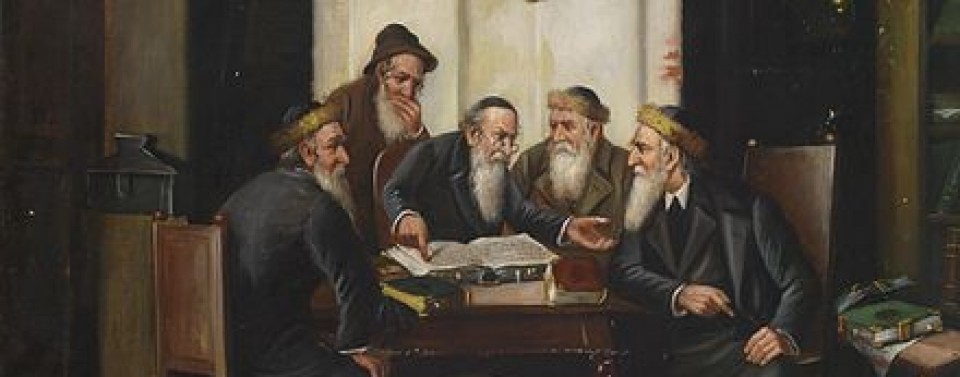
• About Today’s Rabbi

Today's Rabbi

~ …for you, a little wisdom!

Today's Rabbi

Category Archives: Uncategorized

Living Presence

08 Monday Feb 2016

Posted by joelaur in Contemporary Sages, Uncategorized

≈ Leave a comment

Tags

dalai lama, peak performance, presence, present moment, worry

“Man sacrifices his health in order to make money. Then he sacrifices money to recuperate his health. And then he is so anxious about the future that he does not enjoy the present; the result being he does not live in the present or the future; he lives as if he is never going to die, and then dies have never really lived.”- Dalai Lama

beauty-of-nature-3

Remember the old saying; “Today is the tomorrow you worried about yesterday?” Living in any moment but the current one is literally impossible, so it may be that whenever we are captured by past regrets or future worries we are not living at all, but merely holding space in the present. When we are absorbed in any moment but this one, people around us notice a vacancy; some of us live hours, days, lifetimes in that state.

When we are fully absorbed in the present moment however, we seem vibrant, younger, more alive. We are in the flow, in it and part of it. I led services with a local Jewish community one Shabbat morning. I very much wanted to make a good impression, to inspire and engage them, and I also wanted to try some new things musically, and to stretch into some more challenging approaches, like chanting the Torah portion in both Hebrew and English.

On some days leading up to the service, I was nervous, doubting myself, wondering why I has even taken the gig. I was living in the future, worried and miserable! But when the day came, I decided I was prepared enough to do what ever was needed in the moment, and I simply relaxed, and prayed, sang and chanted from my heart each moment. Technically, I made a few “mistakes” with some of the new material. But the congregation loved it all, and hearing the Torah in the vernacular. I felt calm and happy, and afterward everyone congratulated me warmly and told me I exceeded expectations! Gee, why did I worry so?

We all perform better when we are present in the present moment. Feel the fear of the future, move through the sadness of the past, but perform in the present. It’s all we’ve got.

What can you just be present to today?

~~~~~~~~~~~~~~~~~~~~~~~~~~~~~~~~~~~~~~~~~~~~

The 14th Dalai Lama (religious name: Tenzin Gyatso, born Lhamo Thondup, 6 July 1935) is the current Dalai Lama. Dalai Lamas are important monks of the Gelug school, the newest school of Tibetan Buddhism which is nominally headed by the Ganden Tripas. The 14th Dalai Lama received the Nobel Peace Prize in 1989, and is known for his advocacy for Tibetans worldwide and his lifelong interest in modern science.

Joe Laur is a father, husband, artist, builder, naturalist, consultant, and EcoKosher mashgiach. He lives with his wife Sara in western Massachusetts, where he serves as head groundskeeper and resident singer songwriter. Send him your favorite teaching quote for commentary. He can be reached at joe.laur@joelaur.com.


Throw Yourself Like Seed

07 Sunday Feb 2016

Posted by joelaur in Historic Voices, Uncategorized

≈ Leave a comment

Tags

life's work, Miguel de Unamuno, mission, passiion, work

“Throw yourself like seed as you walk, and into your own field…”

-Miguel de Unamuno

seed-falling

This poem by Miguel de Unamuno urges us not to let the past weigh us down, or old longings hold us back, but to turn our selves to our work. Not just our daily jobs, but the work for which we were uniquely created and are best suited for. Our life’s work.

He says that by planting out lives in the furrows of the field, we may be able to return some day and gather a rich harvest, a harvest of Self and Meaning.  And old adage urges us to “do the biggest thing you can that is not impossible.” Sometimes even the impossible comes to pass as well in the process.

It can be fun as well. Mark Twain’s suggestion was to “Make your vocation your vacation.” As you return to your work today, you might want to ask your self the question;

What is the biggest work I’m here to do? How can I have a blast doing it?

~~~~~~~~~~~~~~~~~~~~~~~~~~~~~~~~~~~~~~~~~~~~~~~~~~~~

Miguel de Unamuno y Jugo (29 September 1864 – 31 December 1936) was a Spanish essayist, novelist, poet, playwright, philosopher, and Greek professor, and later rector at the University of Salamanca.

Joe Laur is a father, husband, artist, builder, naturalist, consultant, and EcoKosher mashgiach. He lives with his wife Sara in western Massachusetts, where he serves as head groundskeeper and resident singer songwriter. Send him your favorite teaching quote for commentary. He can be reached at joe.laur@joelaur.com.

Asking Why?

06 Saturday Feb 2016

Posted by joelaur in Contemporary Sages, Uncategorized

≈ Leave a comment

Tags

Dom Hélder Pessoa Câmara, justice, liberation theology, moral justice, poverty, root causes, social justice, systems thinking, the poor

“When I give food to the poor, they call me a saint. When I ask why they are poor, they call me a communist.”

-Dom Hélder Pessoa Câmara

images-2

Sometimes questions can be revolutionary. Asking “Why?” can make  people uneasy, as the answer may expose structural systemic issues that some powers do not want to acknowledge or deal with.

Sometimes questions can be revolutionary. Asking “Why?” can make  people uneasy, as the answer may expose structural systemic issues that some powers do not want to acknowledge or deal with. In the Bible, both the Original Testament and the New Testament, the words “Poor” and “poverty” appear 446 times, and “Wealth” can be found 1,453 times. the word “Justice,” appears 1,576 times in the Original and New Testaments. Justice is mentioned twice as many times as “love” or “heaven” – and seven times more often than “hell.” You can see where the emphasis is.

Dom Camara’s comment indicates that it is easier and more acceptable socially to apply band aids to problems, to alleviate the symptoms, but not to tackle the root causes. In systems approaches, in order to really tackle a painful persistent problem, we must look beyond individual events and even patterns, to discover the hidden structures that keep the system doing what it’s doing. Like a game of Whack-A-Mole, just responding to the events keeps us busy, but gets us nowhere.  We need to take off the back of the machine and see what gears, pulleys, and relationships keep the moles popping up.

If we don’t change direction, we’ll end up where we’re headed. Practical spiritual work demands we stop rearranging the deck chairs and get down below to see what’s causing the ship to list, realizing it’s the folks in steerage who are most at risk. Besides, systems out of balance will eventually self correct, and often with a whiplash we’d rather avoid. Just ask ask Tsar Nicholas, Muammar Gaddafi or Bashar al-Assad. Nelson Mandela and F.W. de Klerk, by contrast, were able to address systemic injustice sufficiently to avoid a bloodbath and bring South Africa to a better, if imperfect, place. We need to look deep, find root causes, and keep asking “Why?”

What great moral issues concern you today and where can you direct your “Why?”

~~~~~~~~~~~~~~~~~~~~~~~~~~~~~~~~~~~~~~~~~~~~~~~~~~~~~~~~~~~~

Dom Hélder Pessoa Câmara ( February 7, 1909 – August 27, 1999) was a Brazilian Roman Catholic Archbishop. He was the Archbishop of Olinda and Recife, serving from 1964 to 1985, during the military regime of the country. An advocate of liberation theology, he is remembered for his social and political work for the poor and for Human Rights and democracy during the military regime.

Joe Laur is a father, husband, artist, builder, naturalist, consultant, and EcoKosher mashgiach. He lives with his wife Sara in western Massachusetts, where he serves as head groundskeeper and resident singer songwriter. Send him your favorite teaching quote for commentary. He can be reached at joe.laur@joelaur.com.
Heaven Is Open To Tears

05 Friday Feb 2016

Posted by joelaur in Rabbinic Sages, Uncategorized

≈ Leave a comment

Tags

grief, grieving, prayer, Rabbi Eleazar, repentance, tears

“From the day the Temple was destroyed, the (Heavenly) gates of prayer have been closed…..But even though the gates of prayer are closed, the gates of tears are opened…”

-Rabbi Eleazar ben Azariah (Babylonian Talmud 32b)

images

There is a Talmudic story about a man, Eleazar ben Durdia (no relation to today’s quoted rabbi), who visited every prostitute he ever heard of. While in the throes of passion with a woman to whom he had paid a huge sum and crossed seven rivers to be with, she passed gas, and told him that just as her gas would not return, he could never repent enough to gain a place in the next world. He was mortified, and saw immediately how depraved his life had become. He retired to the nearby hills, where he cried to the heavens and earth,  mountains and hills, sun and moon, stars and constellations. None could help. He said, “It is upon me then”, and wept so grievously that his very soul departed his body. At that moment a voice for the heavens cried out, “Rabbi Eleazar ben Durdia has gained a place in the World-to-Come!”

In his heartfelt repentance, Eleazer ben Durdia had not only found spiritual redemption, but the title rabbi as well, as an example of complete repentance. While hopefully none of us have to go to his extremes, the lesson is that contrite tears can take us to where even heartfelt prayer cannot. Rumi reminds us that “The grief you cry out from draws you toward union. Your pure sadness that wants help is the secret cup.”  Our heartfelt grief, whether it is a desire to be healed, to seek help for another, or to return to our own best and highest way of being, can connect us to the Divine.

The Hebrew word for repentance, tshuvah, literally means return. To return to our true self, the path we want to be on, the direction we want our life to travel. Sometimes when we see how far we’ve strayed from our ideals, we need a good cry to release it all. A key outcome of expressed grief is great release. We may feel we’ve fallen too far to ever get back up again, to ever return home. The good news is, that heartfelt cry can get us a long way to where we long to be. When the gates of heaven, or even our own hearts,  are closed to prayer, they are still open to tears.

What within you cries for release, to return “home”?

~~~~~~~~~~~~~~~~~~~~~~~~~~~~~~~~~~~~~~~~

Eleazar ben Azariah was a 1st-century CE Jewish Mishnaic sage. He was a kohen and traced his pedigree for ten generations back to Ezra the Scribe.

Joe Laur is a father, husband, artist, builder, naturalist, consultant, and EcoKosher mashgiach. He lives with his wife Sara in western Massachusetts, where he serves as head groundskeeper and resident singer songwriter. Send him your favorite teaching quote for commentary. He can be reached at joe.laur@joelaur.com.

Permit Yourself Pleasure

04 Thursday Feb 2016

Posted by joelaur in Historic Voices, Uncategorized

≈ Leave a comment

Tags

permission, permitted pleasures, pleasure, Samson Raphael Hirsch

“When I come before G!D, I will have to answer for many things. But what will I tell Him when He asks me, ‘Have you seen My Alps?'”-Rabbi Samson Raphael Hirsch

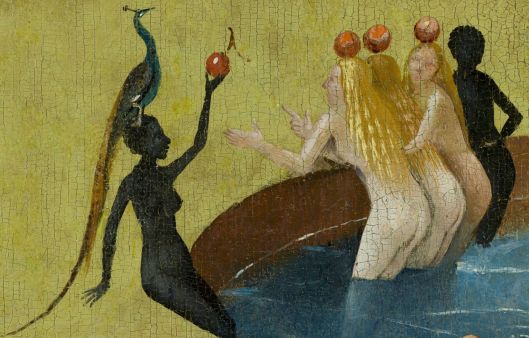
Bosch,_Hieronymus_-_The_Garden_of_Earthly_Delights,_center_panel_-_Detail_women_with_peacock

Toward the end of his life, Rabbi Samson Raphael Hirsch, the great 19th century leader of Orthodox German Jewry, set out for Switzerland by foot. His students asked him why he would risk such a journey at his age, Rabbi Hirsch answered them, “When I come before my Creator, I will have to answer for many things. But what will I tell Him when He asks me, ‘Have you seen My Alps?'”

According to tradition, one of the questions we will each be asked at the end of our lives when we stand before creation is, “Did you partake of life’s permitted pleasures?”

We often think of a spiritual path as one of denial. And to be sure, things like fasting, mastering our urges, developing discipline in our practice, can indeed lead us to spiritual clarity, and for some of us, save our lives from addiction, dissolution and damage.

But pleasure has a holy place too. After all, in Genesis’ creation myth, we are placed in the Garden to enjoy the fruits! (Even the Forbidden Fruit, perhaps. It may be that G!D knew the surest way to get a child to do something is to tell them not to!)

If we are created in the Divine Image, and we have senses of touch, taste, hearing, sight and smell, then isn’t using our senses a holy thing? Alice Walker writes that G!D gets angry if we don’t notice the color purple in a field. Strawberries, sunsets, fresh baked bread, song, wine, the touch of a lover’s hand, the smile of a child; the world is bursting with pleasures that await us. The difference between God and Good is just an “Oh!” of noticing, experiencing, partaking in permitted pleasure.

What life giving pleasure can you enjoy today?

Rabbi Samson Raphael Hirsch (June 20, 1808 – December 31, 1888) was a German rabbi best known as the intellectual founder of the Torah im Derech Eretz school of contemporary Orthodox Judaism. Occasionally termed neo-Orthodoxy, his philosophy, together with that of Azriel Hildesheimer, has had a considerable influence on the development of Orthodox Judaism.

Joe Laur is a father, husband, artist, builder, naturalist, consultant, and EcoKosher mashgiach. He lives with his wife Sara in western Massachusetts, where he serves as head groundskeeper and resident singer songwriter. Send him your favorite teaching quote for commentary. He can be reached at joe.laur@joelaur.com.

Breaking Our Ropes

03 Wednesday Feb 2016

Posted by joelaur in Mystic Voices, Uncategorized

≈ Leave a comment

Tags

afterlife, Joe Laur, Kabir, redemption, salvation

“If you don’t break your ropes while you’re alive, do you think ghosts will do it after?”

-Kabir

rope_beach_bond

This line from one of my favorite Kabir poems has always had a special hold on me. There are many theories and theologies about  heaven, the afterlife, the World-To-Come, reincarnation, and all the other answers to the question, “What happens to us after we die?”

The best and truest answer is probably, “Who Knows?” It’s a matter of faith and hope, and all the evidence is anecdotal. Like the existence of G!D herself, there’s no empirical method to prove it one way or the other. That’s why they call it faith, and both the G!D Fearer and the Atheist have it in spades.

But we do know that death is real, and that what we have is living here and now. The Sages did not put too much emphasis on the next world, sensing that it was much more critical to focus on what we do in this one. Kabir agrees. He tells us to jump into the life we are living, that salvation belongs to the time before death, and that what we create and find for ourselves on this side of the veil, is what we will find on the other side as well.

In fact, it may well be that breaking our ropes here will create the freedom and bliss we long for there. Whatever you long for in the next life; justice, peace, serenity, bliss, grace, wonder; the surest way to achieve it is to practice it here and now. As the musicians Tuck and Patti sing, “Let’s Bring Heaven Down Here”….

What can you do today to create a little heaven in your life or another’s?

~~~~~~~~~~~~~~~~~~~~~~~~~~~~~~~~~~~~~~~~~~~~~~~~~~~~~

Kabir (Kabīr) was a 15th-century Indian mystic poet and saint, whose writings influenced Hinduism’s Bhakti movement and his verses are found in Sikh’s scripture Adi Granth. His early life was in a Muslim family, but he was strongly influenced by his teacher, the Hindu bhakti leader Ramananda.

Joe Laur is a father, husband, artist, builder, naturalist, consultant, and EcoKosher mashgiach. He lives with his wife Sara in western Massachusetts, where he serves as head groundskeeper and resident singer songwriter. Send him your favorite teaching quote for commentary. He can be reached at joe.laur@joelaur.com.

Forgiving Ourselves

02 Tuesday Feb 2016

Posted by joelaur in Contemporary Sages, Uncategorized

≈ Leave a comment

Tags

forgiveness, guilt, Rabbi Joshua Loth Liebman, repentance, wisdom

“We achieve inner health only through forgiveness – the forgiveness not only of others but also of ourselves” – Rabbi Joshua Loth Liebman

The Prodigal Son, Rembrandt

Usually when we think of forgiveness, we think of it in terms of others; either forgiving others who have wronged us, or asking forgiveness of those we have wronged. But what about forgiving ourselves for our “trespasses” against our own ideals?

I find self forgiveness the most difficult. I can usually find a way to forgive others without too much difficulty, especially if they acknowledge the hurt they caused me and ask for forgiveness. That melts my heart. If i’m aware of hurting others, I want to make it right between us as well. I don’t like to leave accounts unsettled, or be at odds with people I care about. But what about settling scores with my self?

I’m  my own harshest critic, as many of us are. A friend once told me she had an “inner prosecutor” who reminded her continuously of everything she’d done wrong. She got the idea of hiring an “inner defense attorney” to handle her case! Can we treat ourselves as well as we want others to treat us? As well as we want to treat others? How can we find ways to forgive ourselves, and genuinely return to our highest ideals?

I usually start by imagining how I’d treat a dear friend. If we are supposed to love others as ourselves, that means we have to love ourselves! I ask myself, if someone else had done this thing, fallen short of their ideals with me, would I forgive them? The answer is almost always yes. So why should I be harder than that on myself? Extending forgiveness to ourselves also makes it easier to extend it to others. And we all know that practice makes perfect.

What can you forgive yourself for today, and let it be as dust in the wind?

~~~~~~~~~~~~~~~~~~~~~~~~~~~~~~~~~~~

Joshua Loth Liebman (1907–1948), was an American rabbi and best-selling author, best known for the book Peace of Mind, which spent more than a year at #1 on the New York Times Best Seller list.

Joe Laur is a father, husband, artist, builder, naturalist, consultant, and EcoKosher mashgiach. He lives with his wife Sara in western Massachusetts, where he serves as head groundskeeper and resident singer songwriter. Send him your favorite teaching quote for commentary. He can be reached at joe.laur@joelaur.com.

Some Are Guilty, But All Are Responsible

01 Monday Feb 2016

Posted by joelaur in Contemporary Sages, Uncategorized

≈ Leave a comment

Tags

Abraham Joshua Heschel, evil, refugees, responsibility

“…morally speaking, there is no limit to the concern one must feel for the suffering of human beings, that indifference to evil is worse than evil itself, that in a free society, some are guilty, but all are responsible.” –Rabbi Abraham Joshua Heschel

Refugee camp in Damascus, Syria

I have a cartoon I use in my teaching about understanding systems. In it, a boat is sinking, going down at the bow, while two men in the bow furiously bail water. In the stern, which is still high and dry, two other men sit relaxed and smiling, and one comments to the other, “I’m sure glad the hole isn’t in our end of the boat!”

Rabbi Heschel responds to this kind of indifference by flatly stating that there is no “our end of the boat”, that there is no limit or boundary within we can retreat and not feel concern for others. In fact, he asserts that indifference to evil is worse than evil itself! Those who permit or enable evil are as responsible as those who perpetrate it.

When I visited Birkenau and Auschwitz some 20 years ago, I was struck by the slogan “Never Again” that was adopted by the survivors of the Holocaust. Never again will we be victims. But the rabbi I was with insisted that that did not go far enough. She insisted that the mantra “Never Again!” should mean Never Again a Victim, Never Again a Perpetrator, and Never Again a BYSTANDER. Without all three legs, the “stool” of evil will topple. There are no innocent bystanders. When we become aware of evil anywhere, we are obliged to do something, anything, be cause we are “response-able”, able to respond.

As a friend of mine likes to say, there’s no “them” there, there’s no “there” there, there’s just us, here.

Where can I take “response-ability” in my life to ease suffering?

Abraham Joshua Heschel (January 11, 1907 – December 23, 1972) was a Polish-born American rabbi and one of the leading Jewish theologians and Jewish philosophers of the 20th century. Heschel, a professor of Jewish mysticism at the Jewish Theological Seminary of America, authored a number of widely read books on Jewish philosophy and was active in the American Civil Rights movement.

Joe Laur is a father, husband, artist, builder, naturalist, consultant, and EcoKosher mashgiach. He lives with his wife Sara in western Massachusetts, where he serves as head groundskeeper and resident singer songwriter. Send him your favorite teaching quote for commentary. He can be reached at joe.laur@joelaur.com.

Better Tomorrow Than Today

31 Sunday Jan 2016

Posted by joelaur in Historic Voices, Uncategorized

≈ Leave a comment

Tags

inner work, Joe Laur, perfection, personal improvement, Reb Nachman of Bratslav, tikkun olam

 “If you are not a better person tomorrow than you are today, who needs tomorrow?” – Reb Nachman of Breslov

33-1252864863HrCL

If the Sabbath is about rest and renewal, the rest of the week is about making things happen. “Six days shall you labor and do your work, and on the seventh day you rest.”

This mentioned at least seven times in the Torah and repeated again in the Prophets and the Gospels. We often focus on the imperative to rest one day of seven. But the flip side is that we are also told to work the rest of the week. But what kind of work?

There’s an saying that healing the world is an inside job. So whatever our work in the world may be, it starts with ourselves. With working on our own stuff, our issues, our strengths and weaknesses. That way, whatever our work in the outer world, we are better equipped to do it well.

Reb Nachman reminds us that while we don’t have to do it all at once, we should still strive to make a little progress every day. We are to make tomorrow a bit better than today was. Otherwise, what’s the point of tomorrow?

What work can I do today, to make tomorrow better?

Nachman of Breslov, also known as Reb Nachman of Bratslav, (April 4, 1772 – October 16, 1810), was the founder of the BreslovHasidic movement.

Joe Laur is a father, husband, artist, builder, naturalist, consultant, and EcoKosher mashgiach. He lives with his wife Sara in western Massachusetts, where he serves as head groundskeeper and resident singer songwriter. Send him your favorite teaching quote for commentary. He can be reached at joe.laur@joelaur.com.

Kept by Shabbat

30 Saturday Jan 2016

Posted by joelaur in Historic Voices, Uncategorized

≈ Leave a comment

Tags

Ahad Ha'am, renewal, sabbath, shabbat

“More than the Jewish People have kept the Sabbath, the Sabbath has kept the Jews.”

– Ahad Ha’am

hand_held_sunset_514532

A Palace in Time” is what Abraham Joshua Heschel calls the Sabbath. A day in the week, one in every seven, where we cease from toiling in the creation of the world and simply marvel at the world of creation. Far from being a day of prohibitions and “don’ts”; it is a day where we pause for a moment and see the glass neither has half empty or half full, but just as perfectly filed as it needs to be right now. We don’t work because for today, there is no need to. There is nothing to be done, just to sit back, exhale, and take it all in. A day where it’s ok to put everything off until tomorrow, except maybe love and wonder.

So stop, today, now, even for moment. Notice the vast world around you, that tree, that sky, that perfect glass of water on the table. Taste, and enjoy, permit yourself the pleasure at hand. Tomorrow you can work and worry, but today, let yourself be a kept person. Kept alive by one perfect day.

What can you look at and simply appreciate and bless without change, right now?

Asher Zvi Hirsch Ginsberg (18 August 1856 – 2 January 1927), primarily known by his Hebrew name and pen name, Ahad Ha’am (Hebrew for one of the people), was a Hebrew essayist. He is known as the founder of cultural Zionism. With his secular vision of a Jewish “spiritual center” in Israel, Ha’am strived for “a Jewish state and not merely a state of Jews”.[1]

Joe Laur is a father, husband, artist, builder, naturalist, consultant, and EcoKosher mashgiach. He lives with his wife Sara in western Massachusetts, where he serves as head groundskeeper and resident singer songwriter. Send him your favorite teaching quote for commentary. He can be reached at joe.laur@joelaur.com.

← Older posts
Newer posts →

Recent Comments

Tim Laur's avatarTim Laur on The Danger of Being Certa…
joelaur's avatarjoelaur on The Danger of Being Certa…
Tim Laur's avatarTim Laur on The Danger of Being Certa…
AJ's avatarAJ on The Danger of Being Certa…
Elisheva's avatarElisheva on The Bridge Over Fear

Author

  • joelaur's avatar joelaur
    • What We Don’t Know CAN Hurt Us!
    • The Danger of Being Certain
    • The Soul’s Long Journey
    • Acting Locally and Cosmically
    • The Fullness of the Earth
    • The Enemy is Fear
    • Running Against The Wind
    • Friendship as Food
    • No Place Like Home
    • Not The End Of The World

Blog at WordPress.com.

  • Subscribe Subscribed
    • Today's Rabbi
    • Already have a WordPress.com account? Log in now.
    • Today's Rabbi
    • Subscribe Subscribed
    • Sign up
    • Log in
    • Report this content
    • View site in Reader
    • Manage subscriptions
    • Collapse this bar
 

Loading Comments...