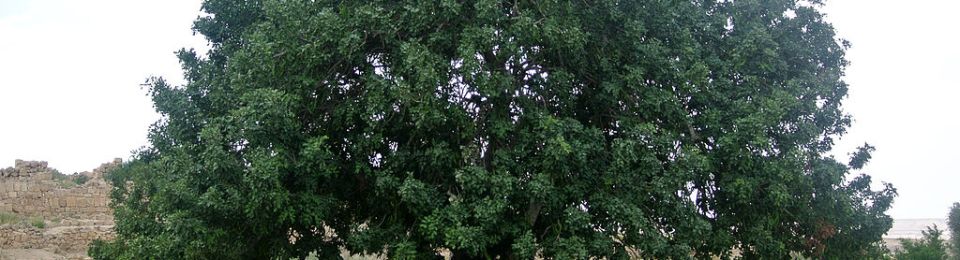
“Honi the Circle Maker was journeying on the road and he saw a man planting a carob tree; he asked him, “How long does it take [for this tree] to bear fruit?” The man replied: “Seventy years.” He then further asked him: “Are you certain that you will live another seventy years?” The man replied: “I found carob trees in the world; as my forefathers planted these for me so I too plant these for my children.”
-Talmund (Ta’anit 23a)

An old Chinese saying goes, “Think a year ahead, plant grass. Think 10 years ahead, plant trees. Think 100 years ahead, educate the people.”
This aggadah about Honi and the carob tree illustrates this point beautifully. It shows the wisdom and the moral strength of planting for the future, even a future that we may not live to see. The carob trees in the story will feed the next generation, but the story itself will educate and feed generation after generation.
If we only think in terms of our own lifespan, we live in a very narrow world indeed. When we consider, with our thoughts and actions, the impact and blessing we can pay forward to future generations, we in habit a world beyond imagination.
What can you do today to grow the future?
~~~~~~~~~~~~~~~~~~~~~~~~~~~~~~~~~~~~~~~~~~~~~~~~~~~~~~~~~~~~~~~~~~~~~~
Aggadah (Aramaic: “tales, lore”) refers to non-legalistic exegetical texts in the classical rabbinic literature of Judaism, particularly as recorded in the Talmud and Midrash. In general, Aggadah is a compendium of rabbinic texts that incorporates folklore, historical anecdotes, moral exhortations, and practical advice in various spheres, from business to medicine.
Joe Laur is a father, husband, naturalist, executive, consultant, and a lowly rabbinic student. Send him your favorite teaching quote for commentary. He can be reached at joe.laur@godsdog.net.
 Today's Rabbi
Pingback: Planting For Those Who Come After Us | Godsdog Howls